


Fraud evolves faster than rule‑based systems can keep up. Attackers constantly invent new tactics, exploit new markets, and probe the edges of every digital product. In my previous article — AI in Fraud Detection and Prevention — I explored how machine learning helps organizations detect known fraud patterns.
But what about the fraud we haven’t seen yet? That’s where Anomaly Detection becomes a game‑changer.
Why Anomaly Detection Matters
Traditional fraud detection relies on history:
Past fraud patterns
Labeled datasets
Known rules and thresholds
But modern fraud doesn’t always look like past fraud. When you enter a new market, launch a new product, or face a novel attack, you often have no fraud labels and no historical patterns to learn from.
Yet fraud still happens.
Anomaly detection solves this by flipping the problem:
Instead of learning what fraud looks like, it learns what normal looks like — and flags anything that deviates.
This makes it one of the most powerful tools for unknown threats.
How Can We Detect “Weird” Behavior Without Past Data?
This is the part that feels counterintuitive, so let’s break it down.
Normal behavior emerges quickly
Even in a brand‑new market, the first wave of users behaves normally:
Typical transaction amounts
Usual login patterns
Common devices and locations
Standard time‑of‑day activity
Within hours or days, you already have a baseline.
Fraudsters behave differently — always
Even without history, fraudsters tend to:
Move faster
Spend more
Retry aggressively
Use multiple devices
Hide behind VPNs
Trigger edge cases
These behaviors naturally stand out.
Anomaly detection is mathematical, not historical
It doesn’t ask:
“Does this match past fraud?”
It asks:
“Does this match the majority of current behavior?”
If 98% of users behave one way and 2% behave very differently, the 2% are anomalies — even if you’ve never seen fraud before.
Isolation Forest: The Workhorse of Anomaly Detection
One of the most widely used algorithms for anomaly detection is Isolation Forest.
Here’s why it works so well:
It doesn’t need labels
It scales beautifully
It isolates rare behavior quickly
It works even with small datasets
It adapts as new data arrives
In Simple words..
Imagine dropping users into a maze:
Normal users end up in the big common rooms
Weird users end up in strange corners
Isolation Forest builds many random “mazes” (trees). If a user gets isolated quickly across many trees, they’re likely an anomaly.
Real‑World Examples
New Market Launch
Most users in a new region spend $5–$50. One user suddenly attempts $900, $1200, $1500.
→ Flagged as anomaly.
New Payment Product
Most users log in from one device. One user logs in from 12 devices in 24 hours.
→ Flagged as anomaly.
Novel Fraud Tactic
Most users complete checkout in 30–90 seconds. One user completes it in 2 seconds using automated scripts.
→ Flagged as anomaly.
No labels needed. No past fraud required.
Where Anomaly Detection Fits in a Fraud System
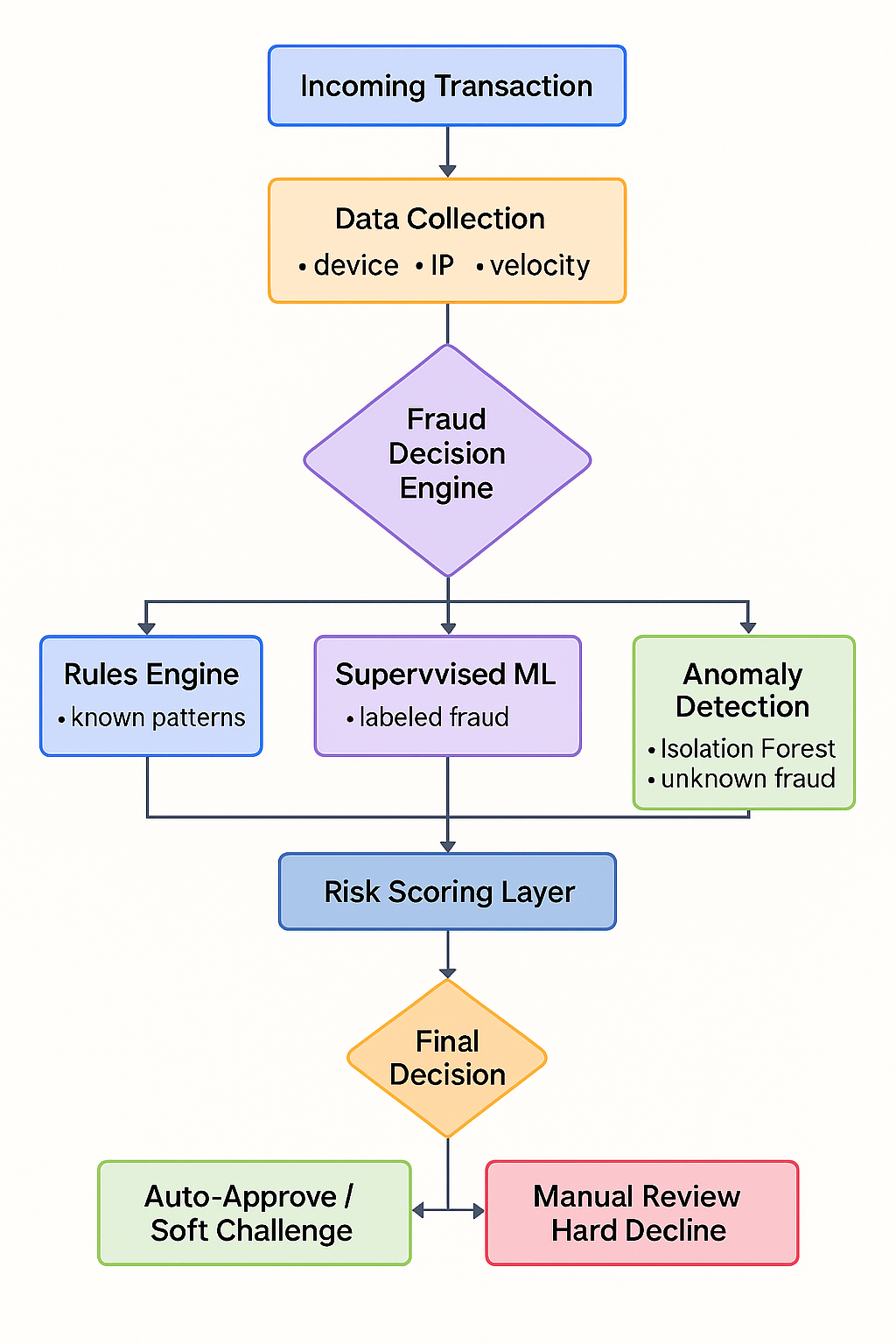
Anomaly detection is not a replacement for supervised ML or rules. It’s a layer in a multi‑layer defense system.
A modern fraud pipeline looks like this:
Rules Engine Quick wins, business logic, compliance.
Supervised ML Learns from known fraud patterns.
Anomaly Detection Catches unknown threats and emerging patterns.
Human Review Analysts validate edge cases.
Feedback Loop Confirmed anomalies become labeled data → improves supervised models.
This layered approach is how companies like Stripe, PayPal, and Revolut stay ahead of attackers.
Challenges & How to Handle Them
False Positives
Early markets have small datasets, so anomalies may be noisy. Solution: gradually increase thresholds as data grows.
Concept Drift
User behavior changes over time. Solution: retrain models continuously.
Interpretability
Anomalies can be hard to explain. Solution: use SHAP, feature importance, and event logs to provide context.
Final Thoughts
Anomaly detection is your early‑warning system. It catches the fraud you don’t yet understand — the kind that slips past rules and supervised models.
If you’re entering new markets, launching new products, or dealing with rapidly evolving fraud tactics, anomaly detection isn’t optional. It’s essential.
This article is part of my ongoing exploration into how AI is reshaping real‑world fraud prevention systems across banking, fintech, and digital payments. Anomaly detection is just one layer in a much broader ecosystem of risk intelligence — and several of the ideas introduced here will evolve into deeper architectural breakdowns, implementation guides, and model‑design discussions in future posts.
If you’re building or operating fraud systems — whether in fintech, banking, payments, e‑commerce, or risk management — I’d love to hear how you approach the balance between AI accuracy*, **explainability*, and *customer experience**, especially when dealing with unknown or emerging fraud patterns.*
Let’s continue the conversation in the comments and learn from each other’s experiences.


